The Arab-Israeli Conflict: A Brief Introduction

The Arab-Israeli conflict is a 100-year-old issue. It all started when Britain took over Palestine after the Ottoman Empire was defeated in WWI. Palestine was in fact inhabited by a Jewish minority and an Arab majority, but the tension between the two increased when the international community gave Britain the green light to establish a “national home” in Palestine for Jewish people.

For the Jews, they considered Palestine to be their ancestral home, but Arab Palestinians also claimed it as their land and refused to leave. Between the 1920s and 40s, the number of Jews arriving in Palestine grew immensely, with many escaping the rise in power of the Nazis in Germany, far away from persecution, and seeking refuge after the Holocaust of WWII. This consequently resulted in violence between Jews and Arabs of Palestine, as well as a revolt against British control.

Trying to find a solution, the British suggested the Peel Plan; to create a very small Jewish state and a much larger Arab state. The Jews accepted the plan, however, the Arabs turned it down. Soon after, the British issued the “White Paper” to limit Jewish immigration to Palestine.

In 1947, during the aftermath of the holocaust which resulted in 6,000,000 Jews killed by the Nazis, the United Nations (UN) voted for Palestine to be split into two states; Jewish and Arab, with Jerusalem being an international city. The Jewish leaders accepted the plan but the Arabs didn’t and the plan was never implemented. In 1948 unable to solve the problem, British rulers left Palestine and Jewish leaders declared the creation of the state of Israel. This is when the catastrophe began.

The Jews later managed to gain a lot of control over most of the territories that were given to them by the UN. It was during this period when the first Palestinian refugee crisis was created, or what is called “Al-Nakba”. Hundreds of thousands of Palestinians left; some left due to a fear of what the Israelis might do to them, some were no doubt forced to leave or expelled by the Israelis themselves.

On May 14th, 1948, the State of Israel was declared, and soon after that, the neighboring Arab states attacked Israel. The following year, cease-fire agreements were signed between Israel and neighboring Arab states. However, by the time the fighting ended, Israel controlled most of the territory. Jordan occupied land which became known as the West Bank, and Egypt occupied Gaza, Jerusalem, on the other hand, was divided between Israeli forces in the West, and Jordanian forces in the East.

Since there was never a peace agreement, each side blamed the other. More wars and fighting took place in the decades that followed.
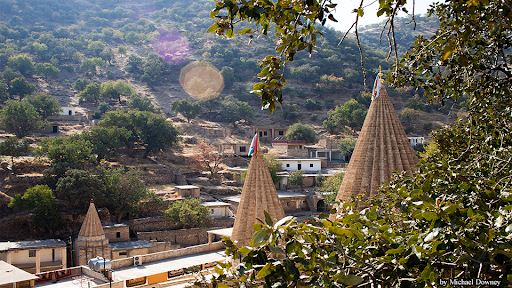
Inside Lalish: The Mountain Valley and Holy Sanctuary of Iraq

Let’s start this article with a question, what’s the first thought that pops into your head when you hear the word, Iraq? Let me guess, Saddam Hussein? oil, explosions, death, trauma, it can really be anything. Iraq has been only perceived as a war zone. There’s this 18-year-old image that only displays chaos, sadness, and tragedy. It’s time to divert from it and see the other side of Iraq. Yes, war scars still exist, but there’s so much more to learn and understand about Iraq’s cultural and religious diversity, rich ancient history, and the countless hidden gems waiting to be explored.

So, since I’m extremely interested in exploring different religions, I came across a piece written on a village in Nineveh, Kurdistan named Lalish, and what struck me most about it, is the fact that this village is actually home to the holiest temple of the Yazidi faith – a quick summary on Yazidism “it’s a monotheistic faith based on a belief in one God who created the world and entrusted it into the care of a Heptad of seven Holy Beings, often known as Angels.” 

Modern research has clarified that the name Yazidi is taken from the modern Persian word “Ized”, which means angel or divine being, so Yazidi simply means worshipper of god, which is how they describe themselves.

Yasdan is their holy supreme, and he’s considered to be on such a high spiritual level “the Creator of the world” that he can’t be worshipped directly, and since he’s considered the creator and not the preserver, there are seven spirits emanate from him to govern, one of which is considered the greatest, is the Peacock Angel or Malak Taus; the executor of the divine will. His other name is Shaytan, in Arabic means the Devil, and this has actually led to the Yezidis being labeled as the “devil-worshippers”.

Yazidis pray to the Peacock angel five times a day, and they believe that souls pass into forms of transmigration and that slow purification is feasible through repeated rebirth which consequently makes the concept of Hell unnecessary. However, the worst thing that can happen to a Yazidi soul is to be expelled from his/her community. As it means that their soul can never progress, therefore, converting to another religion is not even an option.

The majority of Yazidis today live in disputed territories of Northern Iraq, mainly in the Nineveh and Dohuk, with a large Yazidi community in Germany, North America, Turkey, and Syria as well.

Before you enter the ancient village of Lalish you’ll find a check-point at the gate, with guards asking you to take your shoes off. It’s a tradition to enter the village, which mainly consists of a complex of temples, barefoot. You might think it’s odd to be walking around an entire town barefoot but the stone streets are smooth and clean, and it’s an experience that one should definitely not miss. 

Narratives say that for Yazidis, Lalish’s complex of temples is considered the holiest place on earth, as they believe it is where Noah’s Ark first hit dry land after the flood, therefore the birthplace of the new civilization. And so they’re expected to make a pilgrimage to the site at least once in their lifetime and drink from the holy spring water. So in other words, Lalish is to the Yazidis is what Mecca to Muslims or what Jerusalem is to the followers of Islam, Christianity, and Judaism. Lalish is, by all means, the holiest site to this minority faith. 

Yazidi faith is a combination of Christianity, Islam, and Judaism, only pre-dating them by around 1,000 years. It also has segments of Zoroastrianism, Mesopotamian rituals, and some Sufism. However the religion is very misunderstood that it’s often equated to devil worshipping and the reason behind this belief is unlike a member of the three great monotheistic faiths which consider the devil as an evil angel, Yazidis believe the contrary; that he was in fact forgiven, “his tears of redemption extinguished the fires of hell”. This was one of the reasons why ISIS perceived them as apostates. 

In 2014 ISIS militants attacked the province of Sinjar in northern Iraq -a historic heartland for Yazidis. hundreds were killed, thousands were kidnapped, and half a million were displaced. According to the UN in 2015 the attack was described as a genocide, and an UN-funded international investigation was launched to look into ISIS war crimes in 2018. More than six years have passed now, yet Yezidis still face immense challenges; 250,000 still live in camps in Kurdistan and Syria, over 100,000 migrated out of Iraq, and 3,000 are reported missing.

One of Yazidis’ core and actually difficult pillars of their faith is that they are extremely tied to their land. All of their rituals are tied to Lalish; from the baptism in the waters of the sacred springs to the festivals like the new year which they celebrate in Spring all take place in Lalish. So you can only imagine their displacement and forced mass migration is hurting them deeper than losing one’s home.